

Through Snow, Silence and Solitude: Schubert’s Winterreise at the Wrocław Opera
Copyright: Karpati&Zarewicz
Some works of art cannot simply be listened to. They have to be lived through. We must enter their world, surrender to their coldness, solitude and unease, and allow them to linger in the mind long after the final note has disappeared. Franz Schubert’s Winterreise (Winter Journey) is undoubtedly one of those works.
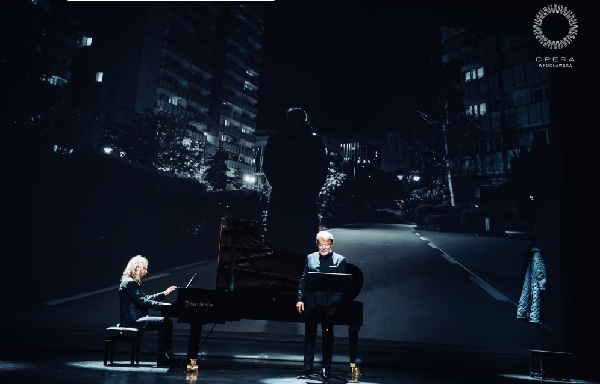
In Wrocław, Schubert’s masterpiece was presented in a distinctive multimedia production that brought together music, spoken word, visual imagery and theatrical interpretation. The result was not merely a performance of a song cycle, but an immersive journey into the psychological landscape of one of the most haunting works in the European canon.
Schubert’s cycle of 24 songs, setting poems by Wilhelm Müller, is among the most enigmatic and deeply affecting works of the nineteenth-century repertoire. The composer completed it only a few months before his death. Yet while this biographical context inevitably lends the work an additional poignancy, it should not define the way we hear it. The power of Winterreise does not depend on the tragedy of Schubert’s own life. Its emotional force is far more universal. This is a work about loss, rejection, loneliness and the search for meaning in a world that has suddenly become strange and inhospitable.
The protagonist leaves his home after being rejected by the woman he loves. He sets off into the snow and darkness, and what begins as a physical journey gradually becomes a journey inward, into the furthest reaches of his own psyche. Each song marks another stage of this experience: pain and grief give way to anger, doubt and isolation, before descending into an increasingly overwhelming sense of despair.
Schubert never tells this story in straightforward narrative terms. Instead, he creates an entire emotional universe through music – often with remarkable economy, yet with an extraordinary power of suggestion. A single harmonic turn, a rhythmic figure or a seemingly simple melodic phrase can evoke an entire psychological state.
Copyright: Karpati&Zarewicz
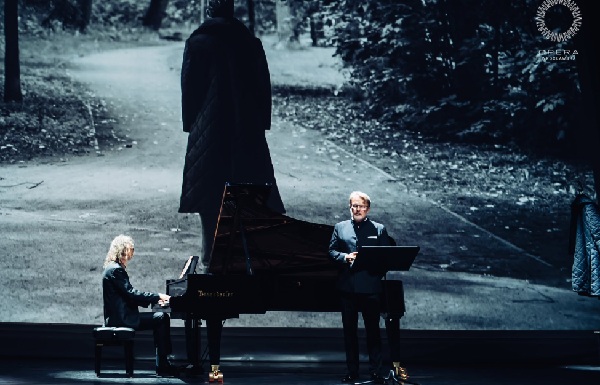
The Wrocław production adds another important layer through the Polish translation by the distinguished actor Krzysztof Gosztyła. Here, translating Müller’s poetry is far more than a practical solution to the problem of language. The spoken word becomes an integral part of the dramaturgy, bringing the protagonist’s inner world closer to the audience. Freed from the distance imposed by a foreign language, the poetry acquires an immediacy that deepens the emotional impact of the performance.
At the centre of the interpretation stands Tomasz Konieczny, an artist whose extraordinary stage presence is familiar to audiences at some of the world’s leading opera houses, including the Metropolitan Opera and the Vienna State Opera. In Winterreise, however, his voice is not simply a vehicle for Schubert’s vocal writing. It becomes an instrument of storytelling.
Konieczny takes the listener through the successive stages of the wanderer’s despair, giving each song its own emotional colour and weight. There is no indulgence in easy theatricality or vocal display for its own sake. Instead, there is concentration, restraint and a clear understanding of one of the great paradoxes of Winterreise: that its deepest emotions often reside not in what is overtly expressed, but in what is left unsaid – in the spaces between the notes.
The pianist Lech Napierała plays an equally crucial role. In Winterreise, the piano can hardly be described as mere accompaniment. It comments, remembers, anticipates and sometimes seems to tell a story of its own. Through it we hear the wanderer’s footsteps, the icy stillness of the landscape, the unease beneath its apparent tranquillity and the vastness of the surrounding emptiness.
The relationship between singer and pianist therefore demands an exceptional degree of precision and mutual awareness. Their interaction is less a matter of one performer accompanying another than of two voices engaged in a continuous dialogue. It is this dialogue that forms one of the foundations of the performance’s expressive power.
What makes the Wrocław production particularly distinctive, however, is its dialogue with the visual arts.
An integral part of the performance is Adam Dudek’s film Winterreise, which he both directed and scripted. Its visual language draws inspiration from the paintings of Caspar David Friedrich, one of the defining figures of German Romanticism. Friedrich’s solitary figures, so often seen from behind as they contemplate immense and seemingly boundless landscapes, seem almost made to inhabit Schubert’s world.
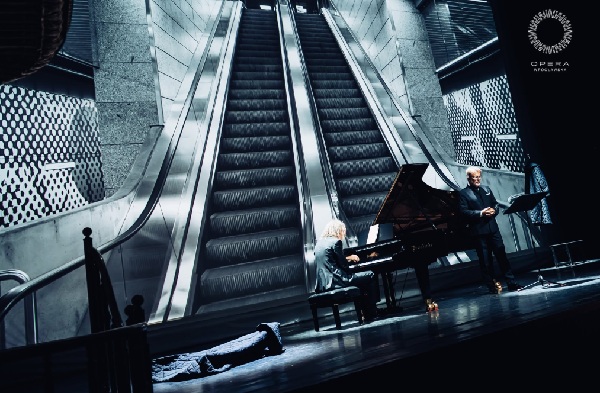
The sequence of 26 video images corresponds to the 24 songs, with an additional epilogue. Yet the film does not function as a mere visual accompaniment to the music. It creates a parallel narrative, offering the audience another way into the work.
We are not only listening to a journey; we are watching one unfold.
The emptiness of the landscape becomes an external projection of the protagonist’s inner emptiness. The recurring figure seen from behind can be read as an image of a human being withdrawing from the world while, paradoxically, desperately searching for a place within it. Friedrich’s landscapes do not simply depict nature. They turn nature into a psychological space – and in this production, that space becomes Schubert’s.
The meeting of Schubert, Müller and Friedrich thus becomes more than an aesthetically compelling synthesis of different art forms. It reveals a profound affinity between their respective visions: the Romantic belief that the natural world can serve as a mirror of the human soul.
Snow, roads, trees, darkness, distant horizons and deserted landscapes are not merely scenery. They become states of mind.
One of the production’s greatest strengths is that Winterreise 3.0 does not attempt to force Schubert into the present day. Its contemporary multimedia language does not overwrite the original work or turn it into something artificially fashionable. Instead, it illuminates meanings that were already there.
Technology and visual storytelling do not compete with Schubert’s music; they create another way of experiencing it. And this is perhaps why a work written almost two centuries ago can feel so startlingly contemporary. Loneliness, rejection, alienation and the search for a direction in life are hardly confined to the Romantic imagination. They remain profoundly familiar human experiences.
The Wrocław Winterreise, then, is more than a concert performance of Schubert’s songs. It becomes a work of music theatre about a human being left alone with himself. About a road whose destination remains unknown. About memory, which refuses to release us from the past. And about a world that, for all its beauty, can nevertheless feel unbearably empty.
Copyright: Karpati&Zarewicz
It is significant, too, that the production was presented at the Wrocław Opera as part of the sixth edition of the Contemporary Opera Festival. Under the direction of Agnieszka Franków-Żelazny, the institution once again demonstrates how opera and music theatre can become spaces in which tradition and modernity meet. A canonical work need not be preserved behind glass; it can become the starting point for a living, contemporary conversation with its audience.
Schubert’s Winterreise offers no easy consolation. It provides no simple answers and no reassuring resolution. Instead, it leaves us with a question that is perhaps more disturbing precisely because it remains unanswered:
Where does a human being go when everything that once gave meaning to the journey has been lost?
Perhaps this is why, when the final note has faded and the empty winter landscape remains before our eyes, the strongest impression is not that the journey has ended.
It is that it is still going on.
Iwona Karpińska
Wrocław