

Salome at the Wrocław Opera – Between Passion, Obsession and the Boundaries of Good Taste
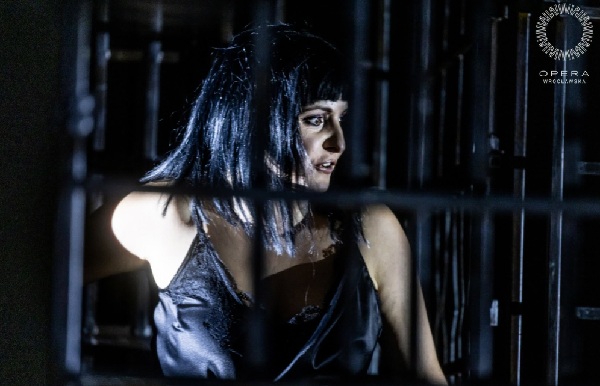
Foto. Karpati&Zarewicz
Richard Strauss’s Salome, directed by Mariusz Treliński, is a production that leaves no audience member indifferent. It is a story of desire, power, fascination and obsession, but also of the loneliness of a human being trapped within their own desires. Nothing in this story is innocent, and beauty is constantly intertwined with unease. Strauss’s music, demanding extraordinary discipline from the performers and a keen sense of musical drama, presents a genuine challenge to both the creative team and the artists.
Yaroslav Shemet stood at the conductor’s podium, leading the orchestra through a dense score charged with tension. There is no room for arbitrariness in this music: emotions build, change direction and, at times, almost overwhelm us, only to reveal their fragility moments later. This is precisely where the power of Salome lies. The music does not merely illustrate the events unfolding on stage; it becomes an independent language of passion and anxiety.
Natalia Rubiś, in the title role of Salome, particularly caught my attention. Her performance was one of the highlights of the evening. The artist faced a role that is exceptionally demanding both vocally and dramatically. Salome is not a character who can be portrayed merely as a capricious princess. She is a woman in whom innocence mingles with cruelty, curiosity with fascination, and the desire for intimacy with the need to dominate another human being.
Natalia Rubiś succeeded in giving the character both vividness and dramatic intensity. Her interpretation revealed not only the force of Salome’s desire but also her inner turmoil. In such a demanding role, it is essential to maintain a balance between stage expression and musical precision. Her performance deserves particular recognition because Salome requires not only a powerful voice but also the courage to create a character who is neither easy to like nor simple to judge—especially in Treliński’s production, in which the title character confronts the traumas of her childhood.
A House of Daggers—this could be the title of the Dance of the Seven Veils: pain expressed through dance, intertwined with the desire to deliver justice. The dance becomes more than a sensual spectacle; it suggests an attempt to give physical expression to suffering and the longing for retribution.
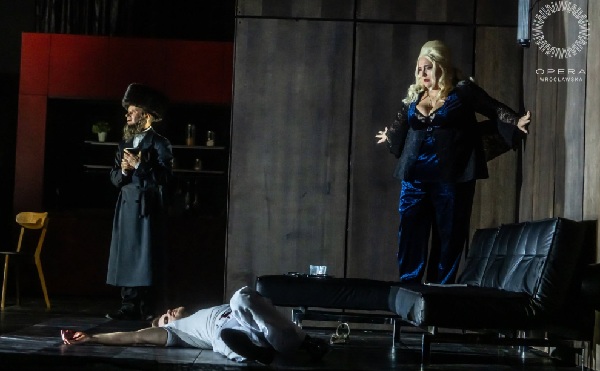
Foto. Karpati&Zarewicz
Salome’s onstage family—Herodias, portrayed by Barbara Bagińska, and Herod, played by Oleg Lanovyi—convincingly portrayed a dysfunctional family dynamic and delivered excellent performances in the unfolding intrigue, and Tomasz Kumiega’s voice as Jochanaan sounded deeply moving as it rang out from the opera house balcony.
Mariusz Treliński once again approaches opera as a theatre of extreme emotions. His staging invites us to reflect on where fascination ends and destructive obsession begins. In Salome, eroticism is not merely decorative; it is one of the driving forces behind the entire tragedy. At the same time, one may feel that such a strong emphasis on the body and psychological intensity risks shifting the focus away from the musical and dramatic depth of the work towards provocation itself.
And this is where the question of the limits of stage expression arises. Does contemporary opera need to emphasise the physical dimension of desire so strongly in order to speak to modern audiences? Or does the greatest power of this story lie in what remains unspoken, in the tension between desire and the impossibility of fulfilling it? These are not questions that require definitive answers. What matters, however, is that a production leaves room for personal reflection rather than inviting admiration solely for the scale and boldness of its staging.
The most telling comment on the evening, however, came not from the stage but as I was leaving the auditorium. A woman walking behind me asked: “Did you enjoy the performance? How many times can someone sing about wanting to kiss somebody?”
This remark, presumably made spontaneously, became an intriguing postscript to the performance. It can be taken with a smile, yet it also raises an important question about how opera is received by its audience. For one spectator, repeated declarations of love may seem tedious, incomprehensible or irritating, even provoking a desire to interrupt them. For another, they become a musical expression of an obsession that grows ever more intense.
In Salome, a kiss is no ordinary gesture of affection. It becomes a symbol of desire that crosses all boundaries and ultimately leads to tragedy. What may seem to one person like a monotonous return to the same subject may appear to another as a deliberate means of building dramatic tension.
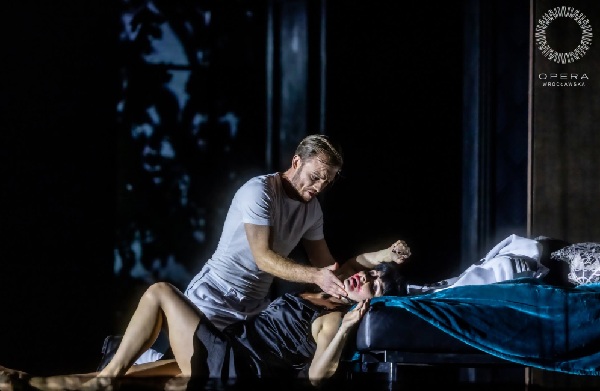
Foto. Karpati&Zarewicz
Perhaps this is precisely the point of experiencing opera: we do not all have to respond to it in the same way. Not every production must delight us in every detail, but it is worth giving ourselves the opportunity to discuss what we have seen and heard. Sometimes a single remark overheard in the theatre foyer remains in our memory as vividly as a scene on stage. Sometimes, too, it reveals how easily a misunderstanding can arise.
It is also worth remembering the people who shape an institution such as the Wrocław Opera. During the period to which this review refers, Agnieszka Franków-Żelazny serves as General Director of the Wrocław Opera, while Tomasz Konieczny, an acclaimed artist on the world’s leading opera stages, holds the position of Casting Director. Their work contributes to the theatre’s artistic development, repertoire planning and standing within cultural life. An opera house needs both daring productions and outstanding performers capable of breathing new life into familiar masterpieces.
Salome at the Wrocław Opera remains an event that invites discussion. For me, one of the most important aspects of the evening was Natalia Rubiś’s portrayal of the title character. She undertook the difficult task of creating an intense, ambiguous figure entangled in tragic desires. Not every directorial choice will convince every spectator, but that is precisely why going to the opera matters: to experience, compare, admire, sometimes disagree and, above all, form our own opinions.
Sometimes it is only when an artist is absent from the stage that we fully realise just how remarkable a character they have created. This was also the case with Natalia Rubiś. When I attended a second performance at which her voice was absent, her artistic presence became even more striking in retrospect. I found myself hearing her interpretation more clearly in my memory than I had while she was actually singing. Her portrayal had been so deeply marked by Treliński’s distinctive theatrical vision that the character seemed to remain present even in her absence. It was then that I fully appreciated how profoundly Rubiś had shaped her Salome.
Finally, I would particularly like to encourage fellow OnlineMerker reviewers to visit Poland, explore our opera houses and concert halls, and attend performances and concerts by Polish artists. It is equally worthwhile to discover the work of artists born in other countries who have chosen to become Polish, made Poland their home and developed their talents here, achieving an exceptionally high artistic standard. Their presence enriches our culture and reminds us that art knows no national boundaries.
Come and discover Poland’s opera houses and concert halls! There is so much to explore on our stages. Listen to the artists who contribute to Polish cultural life and discover for yourselves that Polish opera houses and concert halls hold an important place on the European musical landscape.
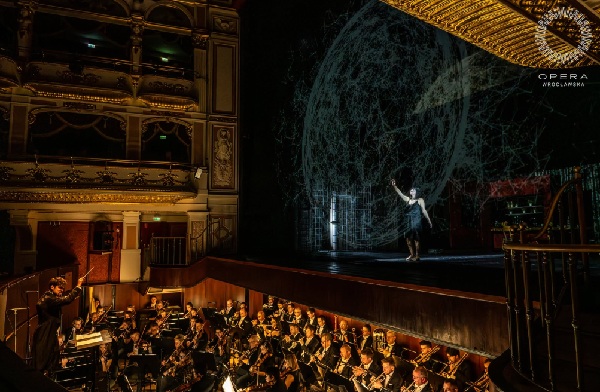
Foto. Karpati&Zarewicz
May encounters with Polish artists—in equal measure those born here and those who have chosen Poland as their homeland—inspire further journeys, new discoveries and reviews published in the pages of OnlineMerker.
Iwona Karpińska
Wrocław, Poland