

TOSCA IN JOHANNESBURG – FLORIA, MACH DEINEN SPRUNG! (30.7. 2023)
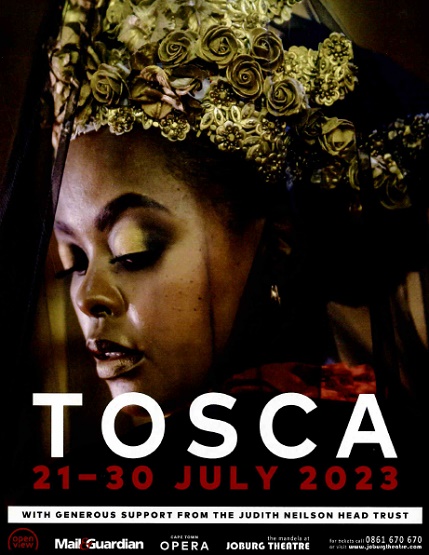
“Tosca’musz man nicht vorstellen; diese Oper hat alles, was zu einer dramatischem Stueck gehoert; politische Unterdrueckung, Leidenschaften, rasende Eifersucht, opulente Massenszenen, lyrische Momente, Erpressung, zynischer Machtmissbrauch, sexuelle Noetigung, Mord, Justizmord und alle drei Hauptcharaktere sind am Ende tot; wie es sich gehoert. Und natuerlich Puccinis phantastische und aufruettelnde, farben- und facettenreichste Musik. Dieses phantastische Drama laesst sich nur opulent, katholisch, barock und Hochklassisch inszenieren und darstellen. Waehrend in Salzburg offenbar Verdis’”Macbeth” verhunzt wird, letztes Jahr in Muenchen der “Rosenkavalier’einem ordinaerem Regieattentat zum Opfer fiel ( Der neue Merker berichtete) und Ringinszenierungen in Bayreuth anscheinend auch nur mehr ein anmassendes kulturnihilistisches Kasperltheater kuenstlerischer ueberforderter Pseudoregisseure sind, zeigt uns die Oper Kapstadt unter Magdalene Minnaar wie man grosse Oper inszeniert – der Begriff leitet sich von der Beweichraeucherung des Altars im klassischen Roemischen Messritus ab – und, so hat es zu sein: zelebriert. Harry Kupfer, einer der ganz grossen ( und dabei immer bescheidenen) Regisseure hat es gewusst: 80 Prozent dessen, was man ueber eine Oper wissen musz, ergibt sich aus Musik und Libretto. Und genau dies hat Magdalene Minnaar unter Studium des historischen Hintergrundes ( Schlacht von Marengo am 14.Juni 1800, unter den damals langsamen Nachrichtenverhaeltnissen absolut glaubhaft, dasz die Geschichte drei Tage spaeter spielt ) beachtet , ein grossartiges Saenger- und Produktionsteam versammelt und opulent, blutvoll und hochdramatisch inszeniert.
Fangen wir einmal damit an, dasz sich das Produktionsteam von einem katholischen Priester in den liturgischen Fragen, die sich ja im 1.Akt ergeben, beraten lies. Und das machte den 1.Akt und insbesondere dessen Schluss zu einem opulenten katholischen Schaustueck wie auch die Inszenierung den toedlichen Gegensatz zwischen jakobinischen Revolutionaeren, deren Hoffnung Napoleon ist, und der katholischen Staatsmacht aesthetisch und szenisch erstklassig herausarbeitet.
Das Buehnenbild ist intelligent und gediegen gemacht, man ist im 1.Akt in einer roemischen Kirche , im 2.Akt im Palazzo Farnese und im 3.Akt auf der Engelsburg. Architektonische Elemente des Buehnenbildes – die klassischen Boegen und Saeulen – ziehen sich durch alle drei Akte und bilden quasi ‘Bruecken” in einem Drama, das in der Stadt des pontifex maximus spielt. Darauf musz man kommen. Die Beleuchtung ist stimmig, die Kostueme hervorragend und in klassischer Manier entworfen.
Alle drei Akte sind souveraen gestaltet. Katholische Opulenz und erotische Spannung mit einer langsam wachsenden Bedrohung durch politische Repression im 1.Akt. Der 2.Akt stellt Scarpia in seiner zynischen Macht- und Genusssucht auf dem Fundament herrlicher Renaissancegrausamkeit dar. Bei einer Folterung kann man durchaus ein Glas guten spanischen Rotweins geniessen, wieso nicht. Diese Oper ist Verismo und Verhoer, Folterung, Erpressung und sexuelle Noetigung sind krass und muessen krass dargestellt werden. Aber dennoch blieb die Regie stilvoll und glitt nicht ins Derbe ab. Dasz Scarpia schliesslich mit seinem eigenen Bratenmesser getoetet wird, ist pikant. Auch der 3.Akt ist stimmig und wir geniessen den Blick von der Engelsburg auf den Peterdom. Wunderbar, wie bei der ‘Sternenarie’ im Hintergrund der naechtliche Himmel eingeblendet wird.
Ganz allgemein sind die Personenfuehrung , Bewegung und Gestik, Buehnenbilder und die gesamte Technik sehr gut gelungen, aus einem Guss und dramatisch glaubhaft. Beste Arbeit des grossen Produktionsteams, wo oft viele Namen in einer Kunstbetrachtung nicht genannt werden koennen aber hier nicht unvergessen sein sollen.
Ausgezeichnet die Kostume und das gesamte Buehnendesign von Maritha Visagie und Leopold Senekal. Besonders schoen, offenbar durch IMMAGIKA Haute coutiere gestaltet, waren die Gewander der Tosca.
Auch die Buehnen – und Lichttechnik( Oliver Hauser) sowie die Bewegungsfuehrung (Fiona du Plooy) mit den optischen Einfuehrungen zu den drei Akten und die Gestaltung des Programms waren erstklassik, aesthetisch auf hoechstem Niveau und sehr ansprechend.
Die musikalische Regie, die schliesslich von intimen Paarszenen bis zu grossen Chorszenen viel bewaeltigen musz, wurde von Adam Szmidt souveraen gestaltet.
Es spielte das Johannesburger Philharmonische Orchester unter der Stabfuehrung von Adam Szmidt. Prachtvoll gespielt und lebhaft, mitreissend realisiert nur manchmal war das Blech ein bisschen zu laut ( wie lautet eine Anweisung von an den Dirigenten ? Wenn Du das Blech hoerst sind sie schon zu laut). Nichtsdestotrotzweniger eine erstklssige Leistung der Instrumentalisten und des Dirigenten.
Dem “ Nelson Mandela “ Stadttheater Johannesburg sei fuer eine sehr gute Organisation gedankt.
Bevor ich zu den Saengern komme, darf ich einige kleine Einwaende erheben , die aber am sehr,sehr positiven Gesamteindruck nichts aendern.
Beim Angelusgebet sollten die Chorschueler sich der Madonnastatue zuneigen und nicht woanders hin blicken.
Voellig richtigerweise erscheint Floria Tosca als brave und glaeubige Katholikin – wie in romanisch gepraegten Laendern ueblich oder noch ueblich – bei ihrem ersten Auftritt mit Spitzenmantilla ; weisz aber dann nicht so recht, was sie mit der Mantilla tun soll. Ein Ratschlag: solange die Dame in der Kirche verweilt, bleibt die Mantilla am Kopf.
Einerseits war das Kostuem des Scarpia klassisch geschnitten und elegant, andererseits scheint ‘weisz’ mir keine angemessene Farbe fuer einen grausam-zynischen Polizeichef zu sein.
Im 2.Akt meldet Spoletta angstbebend dem Scarpia, dasz Angelotti nicht gefunden wurde und setzt sich dann auf einen Stuhl am Tisch des Scarpia. Nein, das tut ein Untergebener nicht, vor allem, wenn er einen Fehlschlag melden musz.
Im 3.Akt war mir die Requisitenansammlung auf der Hoehe der Engelsburg nicht ganz klar.
Ein Gefaengniswaerter raucht im Jahre 1800 keine Zigarette.Punkt.
Und eines ist bei einer Hinrichtung durch Erschiessen ganz klar ( und klassisch). Der zu Exekutierende steht aufrecht und mit dem Gesicht zum Erschiessungskommando. Hier kniete er und schaute ins Publikum. Un errore……
Der Drill des Exekutionskommandos (hier schlaegt bei mir der fruehere Offizier durch) koennte straffer sein. Gut, es ist keine Elitetruppe aber dennoch …
Noch etwas; Tosca erscheint im Reisemantel (richtig, da ja beide gleich fliehen wollen) aber noch immer im Abendkleid .Dabei ( sie sagt es ja Mario selber ) hat sie Schmuck und Gold fuer die Flucht eingepackt, wieso also traegt sie nicht bequeme und unauffaellige Reisekleidung?
Der Tod der Tosca war stimmig: dasz sie von den Haeschern des ( inzwischen verblichenen Scarpia) eingefangen wird, diesen in einem Handgemenge eine Pistole entreisst und sich dann mit dieser erschiesst ist zwar durchaus stimmig, einfallsreich, mit grandioser Lichttechnik unterstuetzt und entspricht dem hochdramatischen Verlauf der letzten Minuten aber “nix da ‘; Tosca hat zu springen.
Abgesehen davon – und ich hoffe, ich bin nicht zu Beckmesserisch- eine tadelose, grandiose Inszenierung.
Und nun zu den Stimmen:
Der Chor wurde von Paul Ferreira excellent gefuehrt und war erstklassig. Richtig suess, bezaubernd der Kinderchor unter der Leitung von Elena Neethling.
Jenna-Marique Macklin ist ein bezaubernder Hirtenknabe, Gora Dlamini und Lwazi Dlamini als Schergen machen das beste aus diesen kleinen, wenig dankbaren Rollen. Van Wyk Venter als Spoletta ist ein sehr guter Ober-unterlaeufl, Bonganbi Kubheka in Spiel und Stimme ein herrlicher, erzklerikaler Sakristan und Reuben Mbonambi ein glaubhafter, von der Haft und dem Staatsterror gepeingter Cesare Angelotti.
Conroy Scott war in Spiel und Stimme ein wirklich herrlich zynisch boeser Scarpia, der alle Register eines Boesewichts von Rang und Stand , von charmanter Verlockung bis brutaler Gewalt zog. Absolut glaubhaft, dasz ganz Rom vor ihm zittert.
Lukhanyo Moyake war ein hinreissender Cavaradossi, stimmlich mit verliebter auch selbstverliebter Taendelei beginnend um dann am Staatsterror des Scarpia zu zerbrechen. Voellig richtigf laesst er seine Stimme beim zweiten “Vittoria” brechen; ein schwer Gefolterter in Todesangst darf das. Realistisch und mitreissend. Und sein Vortrag der Sternenarie macht seine grosse Liebe zu Tosca und seine Verzweiflung absolut glaubhaft.
Man glaubt schon dasz es nicht besser gehen koennte, aber nun kommt Nobulumko Mngxekeza als Tosca. Eine kraftvolle, dramatische aber dennoch elegante Stimme, ein erstklassisches Spiel – vor ihrer Eifersucht musz man zittern – und besonders beruehrend in 2.Akt. Bei “Vissi d’arte’ wo sie erkennt, dasz ihre heile und behuetete Welt als Saengerin und brave Katholikin zusammenbricht kommen die Traenen und daemonisch ihre Stimme als Racheweib in der Toetung des Scarpia. Auf meiner Maria Callas Skala ( 1-10) 9,5! Sie, aber auch die anderen Hauptdarsteller sollten die internationalen Opernbuehnen im Sturm erobern.
Viele Bravorufo, standing ovations, jede Menge Applaus: voll verdient! Mille Grazie !
Alles in allem: Aufwuehlend, opulent und elementar! “Tosca’wird im Artscape Theater in Kapstadt vom 12. bis 17. September wiederholt werden.Auf nach Kapstadt!
Eines sei noch gesagt. Die Kulturpolitik, private Sponsoren und das Publikum sind sich offenbar zu wenig bewusst, dasz Suedafrika auf Grund der vielzahl vielversprechender und herausragender Saenger eine Grossmacht im Bereich der klassischen Musik und Oper sein koennte was auch fuer die Reputation des Laendes wichtig und heilsam waere. Hier ist viel mehr Engagement und Unterstuetzung noetig.Wir werden das schon schaffen!
Harald Sitta
TOSCA IN JOHANNESBURG – FLORIA, DO YOUR JUMP !
“Tosca’ must not be introduced; this opera possesses everything, which belongs to a dramatic piece; political suppression, enthusiasm, wild jealously, opulent mass scenes, lyric moments, blackmailing, cynical abuse of power , sexual harassment, murder, judicial murder and all three main characters are finally dead; as it should be. And of course in addition Puccinis fantastic and shaking music, rich in colors and facets. This drama can only be directed and presented in an opulent, catholic, baroque and highly classic way. As in Salzburg Verdis’”Macbeth” is obviously perverted, last year in Munich the “Rosenkavalier’ was victim to a vulgar assassination by the direction ( “Der Neue Merker’ reported) ( Der neue Merker berichtete) and direction of the “Ring’ in Bayreuth seem to be not more than an arrogant cultural-nihilistic Punch and Judy show done by artistically challenged wannabe directors the Opera House Capetown under Magdalene Minnaar shows us how to direct and perform great opera, how as it should be to incense and celebrate. Harry Kupfer, one of the really great but always modest directors did know it: 80 percent of what you shall know about an opera comes from the music and the libretto. And exactly that Magdalene Minnaar observed with studying of the historical background ( Battle of Marengo on the 14th of June 1800. Under the slow communication circumstances of that time is is absolutely credible that the story is set three days later ), assembled a great group of singers and a fine production team and produced in an opulent, with full blooded emotions and highly dramatic way.
Let us start with the fact, that the production team let itself advised by a Catholic priest in the liturgical matters which arise in the 1.act. And this made the 1. act and especially the final an opulent Catholic show. The production worked out the deadly conflict between the jacobinist revolutionaries, whose hope is Napoleon and the Catholic state authority in an aesthetic and scenic brilliant way.
The stage is done intelligently and tasteful, you are in the 1.act in a Roman Church, in the 2nd act in the Palazzo Farnese and in the 3rd act on top of the Angel’s castle. Elements of architecture – the classic arches and pillars – go through all three acts and form so to speak bridges in a drama which is set in the town of the pontifex maximus . That you must imagine. The lights are simply right, the dresses excellent and designed in a classical way.
All three acts are produced in a sovereign way. Catholic opulence and erotic tension with a slowly growing threat by political repression in the 1st act, the 2nd act presents Scarpia in his cynical power and hedonistic drive grounded in glorious Renaissance cruelty. During a torture you may enjoy a good glass of Spanish red wine, why not ? This opera is Verismo and interrogation, torture, blackmailing and compelling for sex are crass and must be presented in a crass way. Nevertheless the direction remains stylish and does not turn into vulgarity. That Scarpia is finally killed with his own meat knife is picante. Also the 3rd act is just right and we may enjoy the view from the castle to St Peter’s dome.Fantastic as during the “star aria”the nightly sky is made appearing in the background.
In general the guiding of the actors, movements, gesticulation , the stage and the whole technique are done very well, form a unity and dramatically credible. A first class work by the big production team, where in a review many names are often not mentioned but shall not be forgotten here.
Excellently done the dresses and the whole design of the stage by Maritha Visagie and Leopold Senekal. Especially beautiful, obviously designed by IMMAGIKA Haute coutiere had been Tosca’s gowns.
Also the stage and light technique ( Oliver Hauser) and the movement guidance (Fiona du Plooy)and the optical introductions to the three acts and the design of the program brochure had been first class, aesthetically on the highest level and very appealing.
The musical direction, which finally must overcome situations from intimate scenes a deux up to big choral scenes had been done in a sovereign way by Adam Szmidt .
The Johannesburg Philharmonic Orchestra played under the conduction of Adam Szmidt. The music was gloriously and vivid and fully engaged realized ; only a few times the brass had been too loud ( how goes one of Richard Strauss’ advises to a conductor? If you hear the brass they are already too loud) .Nevertheless first class performance by instrumentalists and conductor.
The “ Nelson Mandela “ theatre Johannesburg may be thanked for a very good organisation.
Before I speak about the singers I may raise some small reservations which do not change the very, very positive overall impression.
At the Angelus prayer the chorister scholars shall knee towards the statue of the Madonna and not in another direction.
Perfectly right Tosca appears – being a true and faithful Catholic – as it was and still is de rigeur in Romanian countries, on her first appearance dressed with a mantilla ; but then she does not seem to know what to do with it. Take a tip from one who knows: as long as the lady remains in Church the mantilla is on her head.
On the one side the dress of Scarpia was cut in a classic and elegant way but on the other hand “white ‘does not seem to me the appropriate color of a cruel and cynic head of police.
In the 2nd act Spoletta reports fearfully to Scarpia, that Angelotti was not caught but then sits himself down in a chair at Scarpia’s table. No, an underling does not do that, especially if reporting a failure.
In the 3rd act the collection of requisites on top of the castle did not appear clear to me.
A jail officer does not smoke a cigarette or cigarillo in the year 1800. Full stop!
And one thing must be with an execution by firing squad evident and classic. The delinquent stands upright and with the face towards the firing squad. Here he knelled with the face towards the audience . Un errore……
The drill of the firing squad ( I can’t deny the former officer) could be more strict.Well, it is not the elite guard but anyway …
Some more: Tosca appears in a travel coat ( right as both want to flee very soon) but still in her evening gowns. But as she told Mario she collected jewellery and gold for the flight then why does not she wear casual and inconspicuous travel dresses?
The death of Tosca had the right atmosphere: that she is caught by the underlings of the meanwhile deceased Scarpia, that she catches in this scrum a pistol and kills herself with it is quite logic, ingenious and supported by grandiose light effects and is in line with the highly dramatic last minutes but no way; Tosca has to jump!
Beside that – and I hope I am not to severe in my critique – a perfect, great production.
And now about the voices:
The choir was guided excellently by Paul Ferreira and was first class. Really sweet, enchanting the children’s choir under Elena Neethling guidance.
Jenna-Marique Macklin is a charming shepherd boy, Gora Dlamini and Lwazi Dlamini as catch-polls make the best out of this small, un-thankful roles. Van Wyk Venter as Spoletta is a very good superior underling. Bonganbi Kubheka in acting and voice a glorious, arch-clerical sacristan and Reuben Mbonambi a credible, by jail and state terror tortured Cesare Angelotti.
Conroy Scott was in acting and voice a really glorious, wonderfully cynical bad Scarpia, who knows all the tricks in the book of a villain of rang and class; from charming seduction to brutal force. Perfectly credible that the whole of Rome trembles before him.
Lukhanyo Moyake was a fantastic Cavaradossi, starts to sing by lovingly also self-lovingly flirting around but then is broken by the state terror of Scarpia. It is totally right that his voices breaks with the second “Vittoria” ; a heavy tortured one in fear of his live may do so.realistic and very moving. And his presentation of the ‘star aria’ makes his great love to Tosca and his desperation absolutely credible.t.
Now, if you believe it can’t become better enters Nobulumko Mngxekeza as Tosca. A powerful, dramatic but also elegant voice, a first class acting – you tremble if confronted with her jealously – and especially moving in the 2nd act. As she is recognizing in “Vissi d’arte’ that her save and protected world as singer and true-blue Catholic is crumbling down the audience is left in tears .Daemonic her voice as woman taking revenge in the killing scene. In my private Maria Callas Scale ( 1-10) gets 9,5! She, but also the other main singers should conquer the international opera houses with storming hands (or voices).
Many shouts of ‘Bravo’, standing ovations, a lot of applause; all fully deserved! Mille Grazie !
All in all: Moving, opulent and elementary! “Tosca’ will be repeated at the Artscape Theatre in Capetown from the 12th until 17th of September wiederholt werden.Up, to Capetown!
One may and must be said in addition: Culture politics, private sponsors and the audiences do not seem to be aware enough that South Africa could be due to its multitude of promising and excellent singers a great power in the realm of classic music and Opera what would also be fine and healthy for the general reputation of our country. Much more initiatives and support are necessary. But we will succeed!
Harald Sitta