

Genova: The Cathedral Era Lives On: Notre-Dame de Paris at Teatro Carlo Felice (Genova – 4 July 2026)
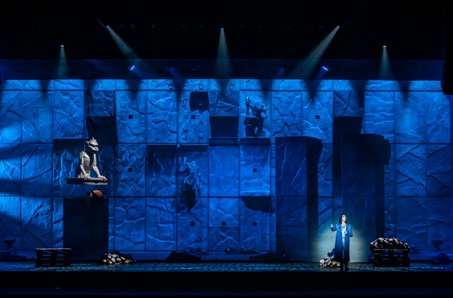
Foto Credit: Luca Marenda
When we hear the phrase ‘Notre-Dame de Paris’, our minds are instantly filled with either the majestic silhouette of the Gothic cathedral or the haunting chords of the iconic song ‘Belle’. Two completely different eras, two entirely different media: a weighty novel from the school library shelves and a dazzling musical show. It is hard to believe, but in the early 19th century, Parisians simply despised Notre-Dame. The great cathedral stood half-ruined, its statues of kings toppled during the French Revolution, its stained-glass windows shattered. Its walls were used for storage, and the city authorities were seriously considering demolishing this ‘medieval rubbish’. Gothic architecture was then regarded as barbaric and tasteless.
Victor Hugo, a passionate defender of antiquity, was horrified. He realised that dry newspaper articles would be of no help – society needed a powerful emotional shock. His novel had the effect of a bomb going off, turning public opinion on its head. A large-scale movement for the restoration of Notre-Dame began in Paris under the leadership of the architect Viollet-le-Duc; it was then that the cathedral acquired its famous spire and gargoyles.
Almost 170 years later, the French poet Luc Plamondon and the Italian composer Riccardo Cocciante (who just recently celebrated his 80th birthday) decided to retell this story through the language of contemporary music. The end of the 20th century was a time when the classical musical genre was seeking a new language, whilst Europe was undergoing tectonic shifts: globalisation, migration crises and the blurring of borders. Gian Marco Schiaretti’s opening aria for Gringoire (‘Le Temps des Cathédrales’) makes it clear that the old world is crumbling, with the new millennium on the horizon, and that people must seek new spiritual bearings. We then hear the powerful manifesto of Clopin and the Gypsies – the song ‘Les Sans-Papiers’ (‘The Undocumented’). In 1998 (as today), this was a highly contentious issue for Europe. Esmeralda and her people in the musical are refugees demanding shelter and recognition of their rights. The cathedral once again becomes a metaphor for a closed, self-satisfied society that refuses to let ‘outsiders’ in. The creators wanted to break the stereotype that musicals are a light, entertaining and easily forgotten genre. They composed a monumental, tragic rock opera, in which the rock rhythm section is combined with monumental, almost church-like choral parts and synthesisers. This creates a sense of a ‘modern Middle Ages’. Every song in „Notre-Dame de Paris“ becomes a standalone, complete radio hit.
Cocciante wrote music that pushes the limits of human capability. His melodies demand immense emotional investment, a specific vocal technique known as ‘belting’, and controlled vocal splitting. The famous ‘Belle’ – performed here by the classic original Italian cast – begins as a tender ballad sung by Quasimodo (Giò Di Tonno), develops into a passionate, lyrical confession by Phoebus (Graziano Galatone), and culminates in Frollo’s (Vittorio Matteucci) dramatic, almost operatic frenzy, highlighting his powerful operatic vocal style. Here we can see that Cocciante brought a completely different aesthetic to the stage – Italian melodrama blended with French chanson and a powerful stadium rock sound.
The best proof of Cocciante’s musical genius is what is happening on theatre stages right now. One might think that after decades, audiences would have grown tired of it, but the Italian version of the musical continues to break records. On Saturday, hundreds of spectators stormed the theatre: the cast had to perform two extremely demanding shows in a single day – a matinee and an evening performance – and both times to a full house. Italy has embraced this musical as its own; the audience, many of whom know every line by heart, give such a standing ovation at the finale that the performers have to sing ‘Le Temps des Cathédrales’ as an encore together with the whole theatre.
And when the audience in Genoa rises as one, you realise that this masterpiece will not gather dust on the shelf of history. The musical is vibrant and emotionally devastating, making your heart beat faster. For anyone ready to experience this grand drama alongside the cast, „Notre-Dame de Paris“ is undoubtedly an evening well spent. An evening that proves: the age of cathedrals will never pass, as long as we have something to sing about.
Darina Leuer