

Starlight and Movement: The Royal Ballet in Nervi
12 July 2025, Genoa

Marianela Núñez credits: Nervi International Ballet Festival
The Nervi Ballet Festival has an impressive history spanning more than half a century. Founded in 1955 by Italian impresario Mario Porcile, this summer music event has become one of the most prestigious in the world of ballet, bringing together a constellation of outstanding artists over the years: from Rudolf Nureyev and Margot Fonteyn to Carla Fracci and other stars of the stage who have left a lasting mark on the history of world choreography. Genoa is a unique city that combines the grandeur of maritime history, architectural heritage and a vibrant cultural present. The picturesque Nervi district, seemingly located on the border between the sea and the lush greenery of the Mediterranean nature, provides the festival with a truly unique natural stage. Open-air performances, against the backdrop of the endless sea and the silence of green trees, create a truly unique atmosphere.
When talking about the Covent Garden troupe, epithets such as ‘one of the best’, ‘a must-see’, ‘the embodiment of tradition and innovation’, and ‘the benchmark for performance standards’ immediately come to mind. The Royal Ballet Company at Covent Garden is the living fabric of ballet history, woven from decades of impeccable taste, artistic intuition and the pursuit of perfection. When talking and thinking about names such as Margot Fonteyn, Rudolf Nureyev, Darcy Bussell, Carlos Acosta, Natalia Osipova and Marianela Nuñez, we undoubtedly feel a sense of awe. These artists created eras, inspired generations, and became part of the cultural code not only of Britain but the entire world. The evening of 12 July in Nervi Park, celebrating the work of Frederick Ashton, is particularly noteworthy. Ashton plays an exceptional role in the history of English ballet, as he laid the foundations for the recognisable style of the Royal Ballet, combining academic rigour with the refined poetry of the British stage. The dance evening, consisting of three acts and six numbers, is a unique tribute to his work, bringing together outstanding dancers from the company who breathed new life into the maestro’s choreography. The programme included several of Ashton’s key works, from the Pas de quatre from Swan Lake and the lyrical refinement of The Dream to the spirited Tango-Pasodoble, the graceful Waltz of the Voice of Spring, the short ballet Marguerite and Armand, and the dazzling Rhapsody. Each of these productions not only demonstrates the breadth of the choreographer’s artistic range but also reveals different facets of his style: from subtle irony to tragic depth.
The Pas de Quatre, interpreted by Isabella Gasparini, Sae Maeda, Harrison Lee and Daichi Ikarashi, took on a new charm, sparkling with fresh intonations thanks to the vivid interaction between the artists and the subtly constructed choreographic dramaturgy. Their movements combined respect for the classical form with modern emotional responsiveness, making this scene particularly moving and lively.
Marianela Núñez credits: Nervi International Ballet Festival
The Dream, performed by Marianna Tsembenhoi and Joseph Sissens, captivated the city, sinking into the bliss of night with its dreamy atmosphere. Their duet was distinguished by a rare subtlety. Here, the dance became poetry in motion, where every touch, glance and step was filled with romanticism and mystery. The artists masterfully conveyed the magical aura of Shakespeare’s fairytale, while maintaining the precision and musicality characteristic of Ashton’s style.
Tango-Pasodoble with Olivia Findlay and Gary Avis captivated the audience with its rhythm, expression, and character play. This miniature became a real explosion of passion — every gesture, every glance was electrified with energy. The artists easily coped with the difficult stylistic challenge, demonstrating both technique and acting skills. The dance felt like an intense dialogue, spiced with a touch of drama.
The act concluded with a beautiful duet, Voices of Spring, in which Meaghan Grace Hinkis and Valentino Zucchetti appeared in complete harmony and lightness. Their dance became a true hymn to awakening nature and love, embodied in fragile but precise movements filled with the breath of spring. The first part of the evening perfectly demonstrated the richness and diversity of Ashton’s choreographic language, as well as the feeling of light, hope, and eternal rebirth that the art of dance can bring to the viewer.
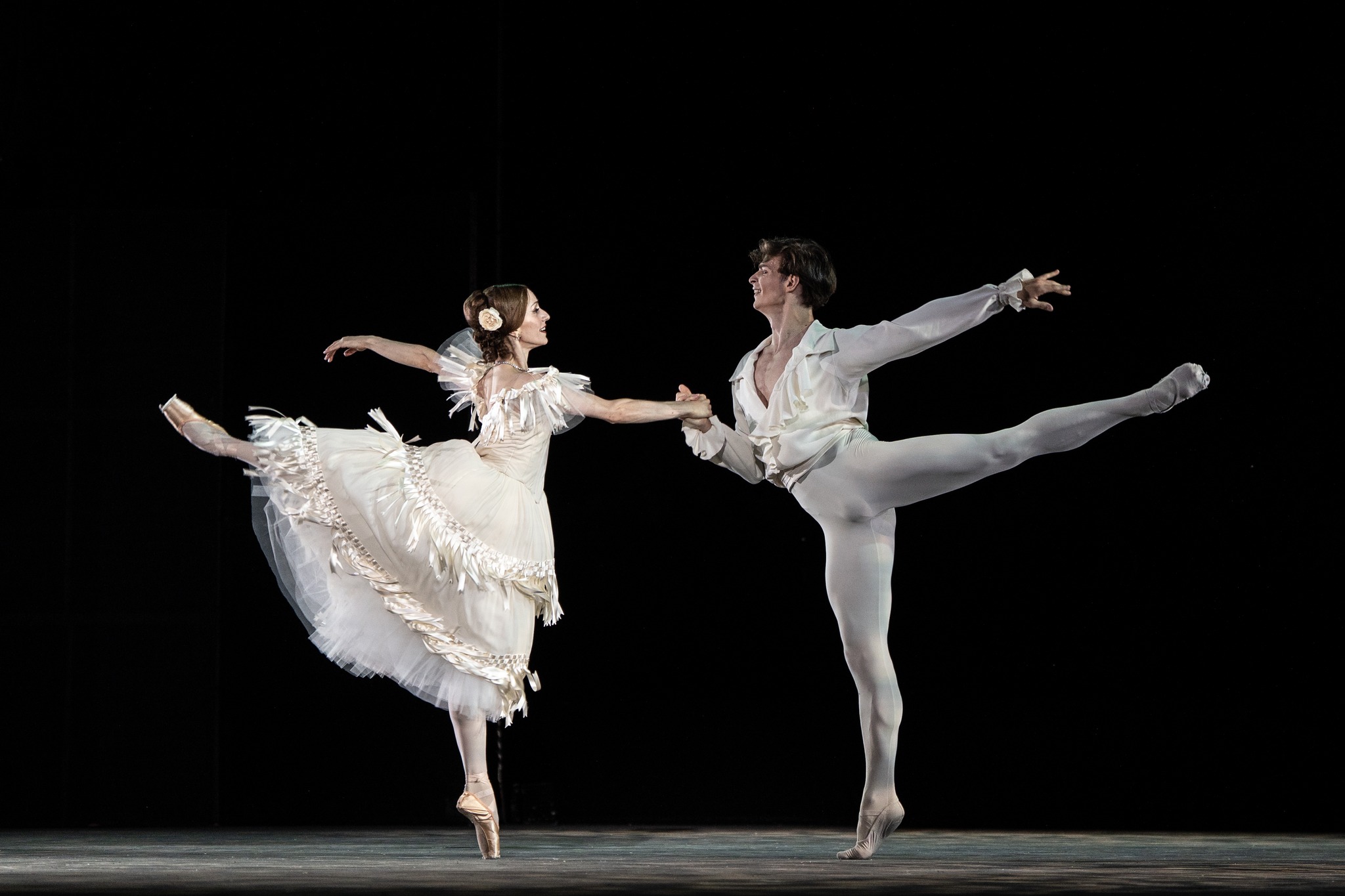
In the second part of the evening, Marianela Nuñez and Jakob Feyferlik shine in the half-hour ballet “Marguerite and Armand” — a moment the audience has been eagerly awaiting. The ballet, first performed in 1963 at the Royal Opera House, Covent Garden, became legendary: according to contemporaries, the curtain rose 21 times after the premiere. Frederick Ashton created this choreographic drama especially for Margot Fonteyn. At the turn of the 1960s, Fonteyn, then 43 years old and the grand dame of English ballet, was seriously considering ending her career, and the ballet, inspired by The Lady of the Camellias by Alexandre Dumas, became not only a farewell to the stage but also a deeply personal confession. Ashton captured the subtle drama of a fading but unbroken woman and translated it into the language of dance — laconic, rich, and impeccably musical.
The first person entrusted with the role of Marguerite after Fontaine was Sylvie Guillem, a ballerina with remarkable physical abilities and, more importantly, a rare magnetic charisma and vivid personality. Today, this legacy is being carried on with dignity by Marianela Nuñez, a prima ballerina who possesses not only technical finesse but also stunning dramatic expressiveness. Her Marguerite is not just a suffering heroine, but a complex, multifaceted woman whose fate unfolds before our eyes with emotional candour. Jakob Feyferlik, in turn, brings to the role of Armand the youthful ardour, emotional honesty and nobility that are so important for the ballet embodiment of this character. Their duet is an intense emotional dialogue, where every glance, every touch is filled with meaning. The dance sounds like a confession, like an inexorable flow of feelings, in which passion, pain, tenderness and farewell are woven into one tragic symphony. This ‘Marguerite and Armand’ is not a museum reproduction of the great duet of the past, but a living, sensual, modern interpretation capable of touching and delighting the viewer, regardless of the era. Looking at the star duet evokes a sense of awe and the feeling of being part of something greater. Brava, Marianela Nuñez! Bravo, Jakob Feyferlik!
The third part concludes with Rhapsody, performed by Mayara Magri and Luca Acri — a brilliant embodiment of Ashton’s style set to music by Sergei Rachmaninoff, one of the most striking demonstrations of how the choreographer was able to interweave virtuoso technique with profound musicality. In this piece, it is particularly noticeable how subtly Ashton felt the structure of the musical work: each passage and every acceleration in the score is reflected in the movement of the body. Magri shines with expression and unpredictability, while Acre impresses with precision, strength and plastic nobility. Their duet is filled with dialogue with the music and the audience. The rhapsody sounds like the final chord of the evening — bright, rich, triumphant. It is a finale in which emotion and skill, body and music, past and present merge.
This evening at Nervi is compelling proof that Frederick Ashton’s legacy is not only preserved, but continues to live, breathe and evolve on the contemporary stage. His ballets, as they did decades ago, resonate with audiences because they are imbued with genuine emotion, humanity and an impeccable sense of form. The Royal Ballet once again confirms its exceptional role as the guardian and continuator of a great tradition, and the troupe of artists shows that Ashton’s language is the language in which ballet can speak to the audience about the most important things: love, loss, hope and transformation. An evening at Parchi di Nervi is an aesthetic delight and an outstanding experience, and at the same time, a reminder that true art always remains alive: timeless, boundless, and unconventional.
DL